This page provides information on the characteristics, uses, etc. of different types of difficult-to-cut material used in microfabrication. It also contains important points to keep in mind during microfabrication and examples of actual microfabrication.
Tungsten
Tungsten is an exceptionally heat-resistant metal with an extremely high melting point and hardness. It maintains its shape even at high temperatures, so it is used in semiconductor equipment components and other applications. It is also brittle, so processing must be designed to avoid placing excess tool loads.
The precision of finished products can be improved by selecting processing methods, such as electrical discharge machining or micro-cutting, based on how the finished products will be used. Using jig designs that suppress vibration during processing and controlling cutting amounts can help reduce chipping and produce smoother finishes.
Processing examples and information on the features of finished tungsten are presented in detail on the tungsten processing case example page.
Stainless steel features superior corrosion resistance and high strength, so it is used in medical components, precision sensors, and the like. While it offers excellent durability, its high toughness and tendency to work harden make it a difficult-to-cut material.
During microfabrication, excessive heat generation and burr formation can negatively impact surface quality and tool life. It is therefore vital to employ sharp-edged tools and optimize cutting parameters to prevent surface hardening. High dimensional accuracy can be achieved by utilizing specialized coatings to reduce friction and applying precise coolant flow to mitigate thermal expansion.
Quartz glass is an exceptionally pure form of silicon dioxide with outstanding optical transparency, high thermal resistance, and low thermal expansion. It maintains dimensional stability across wide temperature ranges, making it essential in optical components, semiconductor equipment, and precision instruments. It is also inherently brittle with low fracture toughness, so processing must be carefully controlled to prevent cracking and subsurface damage.
The precision of finished products can be improved by selecting processing methods, such as diamond wheel grinding, ultrasonic machining, or laser cutting, based on the optical and dimensional requirements of the final application. Using jig designs that minimize vibration and applying fine incremental depth passes can help suppress chipping at edges, reduce surface micro-fractures, and produce the smooth, clear finishes that quartz glass demands.
Processing examples and information on the features of finished quartz glass are presented in detail on the quartz glass processing case example page.
Molybdenum has a high melting point and is highly thermally conductive, so it is used in heat dissipating boards, high temperature reactor components, and the like. While it is easier to work with than tungsten, it is also brittle and cracks easily.
It tends to accumulate heat during microfabrication, and temperature increases can negatively impact its dimensional precision. It is therefore vital to optimize its processing conditions and use a distributed design approach. The amount of deformation can be reduced and precision can be maintained by performing cutting at lower rpms and using highly effective coolant.
Tantalum is corrosion resistant and conductive, so it is widely used in chemical equipment and electronic components. It is a soft metal, but it is prone to work hardening, and the more one cuts, the harder it becomes.
Microfabrication poses two challenges: tool wear and maintaining surface quality. A smooth surface can be maintained by using a lower cutting speed and keeping a close eye on tool wear. Work hardening can also be slowed by using the right cooling conditions, producing a more consistent finish.
Inconel
Inconel is a heat-resistant alloy made up primarily of nickel. One of its notable features is that it can maintain its strength even at temperatures of over 700℃. It is used in semiconductor production equipment, vacuum components, and other places where dimensional accuracy is important.
It has a low level of thermal conductivity, so cutting heat tends to be concentrated, which results in greater tool wear. It is important to prepare a processing environment with sufficient cooling capabilities and to select tools with low cutting resistance. Tool angles and feed speed can be adjusted to reduce the amount of work hardening while maintaining consistent precision.
Hastelloy is suited for use in components which are exposed to chemicals or corrosive gases. It is a nickel-based alloy that can withstand highly acidic and chloridic environments. Its applications include chemical plants and waste gas processing equipment.
It tends to build up heat and is prone to work hardening, so measures must be taken to prevent tool tip wear. Stable cutting can be achieved by using low cutting speeds and selecting tool materials which are highly resistant to wear. Surface roughness improvements can also be obtained by using highly lubricating cutting oil.
[Choose by Fabrication Type] Top Three Recommended Microfabrication Partners
For difficult-to-cut materials
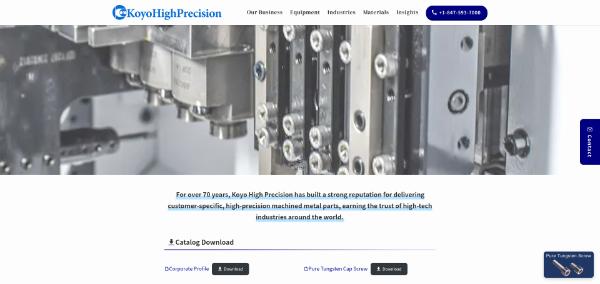
Koyo High Precision
Source: Koyo High Precision website (https://koyohighprecision.com/)
Examples of supported materials
Tungsten, molybdenum, tantalum,etc.
Main fabrication technologies
Micro drilling
Lathe machining
Milling
Why We Recommend
They perform fabrication for a wide range of sizes, from ⌀3 to 220 mm,and they can handle everything from prototype development to mass production fabrication for difficult-to-cut materials
They can achieve a fabrication precision of ±3 μm even for tungsten,which is known for being difficult to cut.