Baker Industries
Open Table of ContentsClose Table of Contents
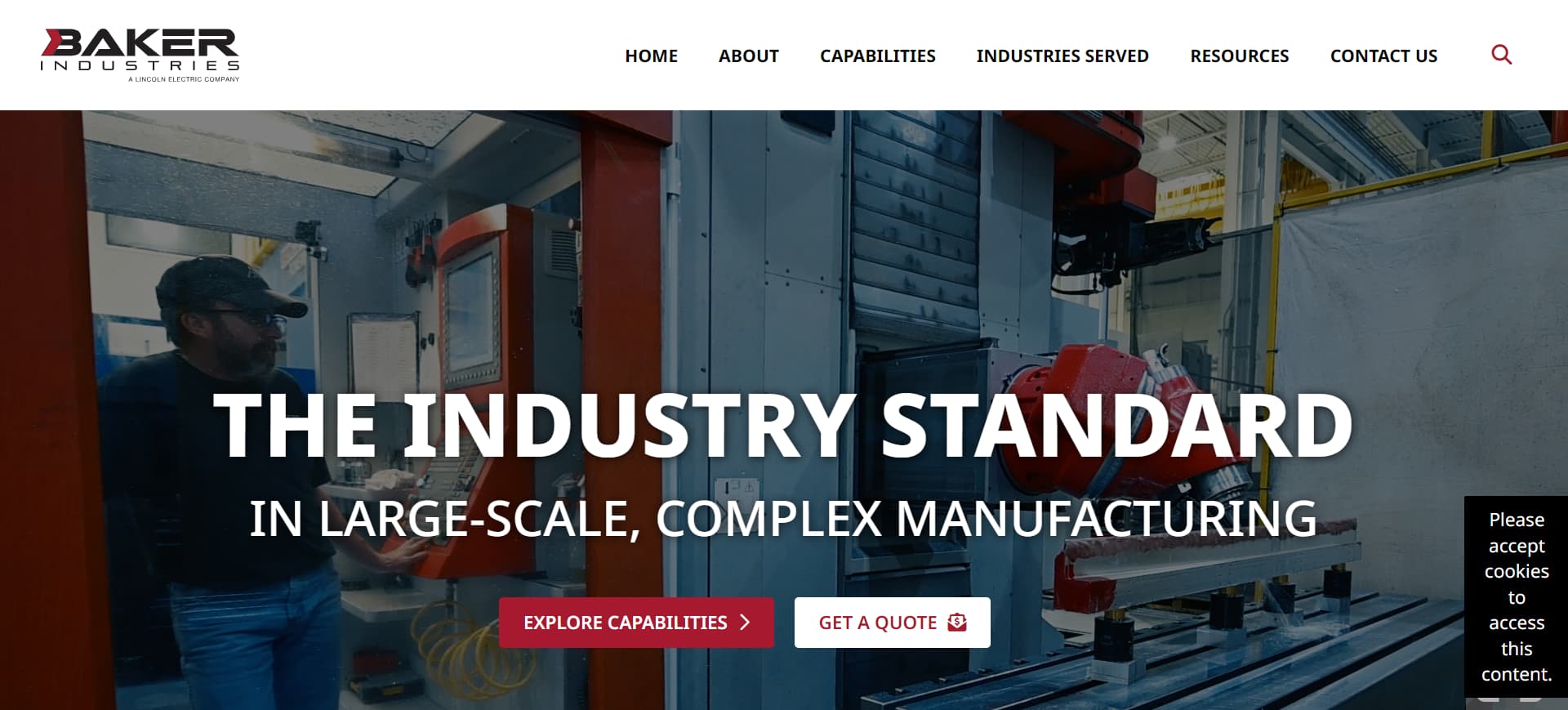
Source: Baker Industries's Official Website (https://www.bakerindustriesinc.com/)
Baker Industries uses state-of-the-art processing technologies such as CNC machining and metal 3D printing to handle everything from prototype manufacturing to mass production of high-precision metal components.
This page introduces the features of Baker Industries' microfabrication, the processing services it offers, processing examples, and more.
Baker Industries' microfabrication services
Baker Industries excels at precision manufacturing using high-precision CNC machining.
It can perform processing for small and medium-sized objects with complex shapes, with a precision of roughly 0.005 mm (±0.0002 inches).
It meets the precision and durability needs of fields such as the aerospace and engine fields.
What's more, its integrated system combines welding, metal 3D printing, and fabrication for high-precision sub-millimeter manufacturing.
Fabrication services
In addition to high-precision machining using five-axis CNC machines, it also offers fabrication and welding services, including MIG welding, TIG welding, and metal forming.
What's more, it offers both resin-based SLS 3D printing and metal 3D printing (metal additive fabrication), covering a wide range of processing needs.
Supported materials
Baker Industries supports a wide range of metals, including superalloys such as Inconel, and plastics, including super engineering plastics such as PEEK.
Its production system is capable of manufacturing special-purpose components that would be unfeasible using conventional materials, and high performance components that require high levels of heat resistance, corrosion resistance, and strength.
Supported sizes
Not listed on the company website
CHECK Finding Your Partner Based on Processing Style
What sets Baker Industries apart is how it combines high-precision CNC machining and metal 3D printing to manufacture components with complex shapes while maintaining consistent precision.
It takes an integrated approach to working with diverse processing technologies to achieve stable quality across the manufacturing process, from prototyping to mass production.
It is also highly suited to the manufacture of metal parts which require high precision and the manufacture of components with complex shapes that are difficult to create using conventional methods. Baker Industries can flexibly meet the needs of a wide range of applications.
In addition to Baker Industries, this site also presents other providers of microfabrication services, categorized by fabrication method to make it provider selection easy.
Please use it to assist you in selecting the partner that's right for your applications and materials.
Examples of Baker Industries' microfabrication
Not listed on the company website
Company Information
| Company Name |
Baker Industries, a Lincoln Electric Company |
| Location |
16936 Enterprise Drive
Macomb, MI 48044
USA |
| Telephone |
+1 (586) 300-3608 |
| Website |
https://www.bakerindustriesinc.com/ |