RapidMade
Open Table of ContentsClose Table of Contents
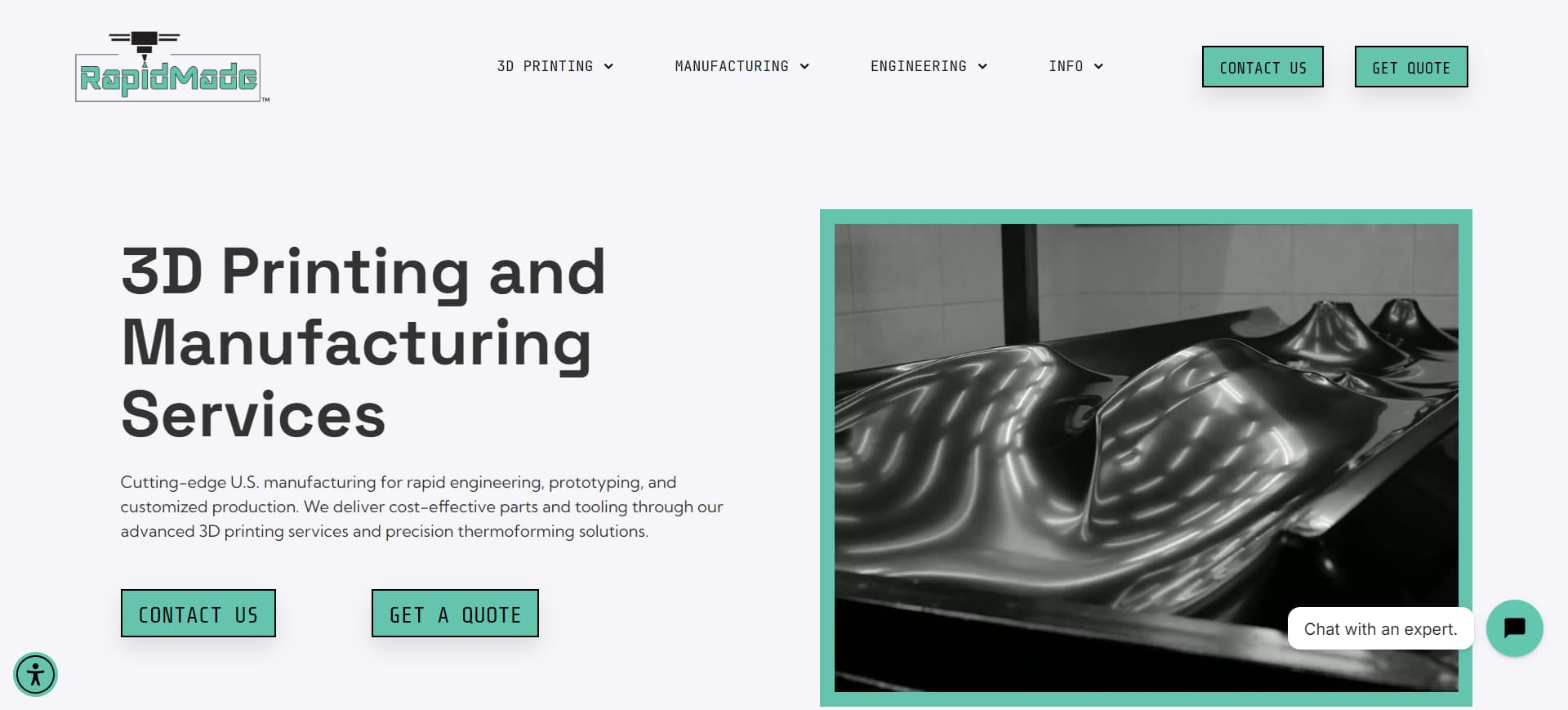
Source: RapidMade's Official Website (https://rapidmade.com/)
RapidMade uses technologies such as 3D printing and CNC machining to fabricate compact precision components and prototypes.
This page introduces its microfabrication features, the processing services it offers, processing examples, and more.
RapidMade's microfabrication services
RapidMade uses 3D printing and stereolithography (SLA) to supply high-precision microfabrication services with minimum thicknesses of 0.1 mm and minimum detail sizes of 0.25 mm.
It can manufacture plastic parts and jigs which require sub-millimeter precision.
Furthermore, it combines these technologies with CNC milling for an even wider selection of processing options. It can also manufacture prototypes of industrial devices, automobile components, medical devices, and the like, and flexibly handle projects with short turnaround times.
Fabrication services
SLA uses photocurable resin, which hardens when exposed to ultraviolet light, to create shapes with a single-layer laminated accuracy of 0.1 mm (100 µm). It can also accurately reproduce minute characters, thin ribs, delicate protrusions and indentations, and the like.
Supported materials
3D printing (SLA) can be used with plastic materials such as ABS, PEEK, urethane, and nylon.
Materials and processing conditions can be selected based on how the finished articles will be used, and component fabrication takes weight reduction, heat resistance, and wear resistance into consideration.
RapidMade also offers CNC machining of metals such as steel, aluminum, stainless steel, and titanium.
Supported sizes
SLA can be used to manufacture articles measuring up to 10.8 inches x 6.3 inches x 15.7 inches (approx. 275 mm x 160 mm x 400 mm).
Batch output is available for up to medium-sized articles.
Designs are recommended to have minimum detail sizes of 0.25 mm and clearances of 0.25 mm (0.010 inch).
CHECK Finding Your Partner Based on Processing Style
One of RapidMade's strengths is that it combines 3D printing and CNC machining technologies for the integrated manufacturing of prototypes that require sub-millimeter precision.
That makes it perfect for shape confirmation and function verification for actual components used in fields such as the industrial, automotive, and medical device fields.
In addition to RapidMade, this site introduces many other providers of microfabrication services, categorized by fabrication method.
Please use it to assist you in selecting the partner that's right for you.
Examples of RapidMade 's microfabrication
Not listed on the company website
Company Information
| Company Name |
RapidMade, Inc. |
| Location |
12141 SW Herman Road
Tualatin, OR 97062
USA |
| Telephone |
+1-(503)-943-2781 |
| Website |
https://rapidmade.com/ |