BMW Precision Machining
Open Table of ContentsClose Table of Contents
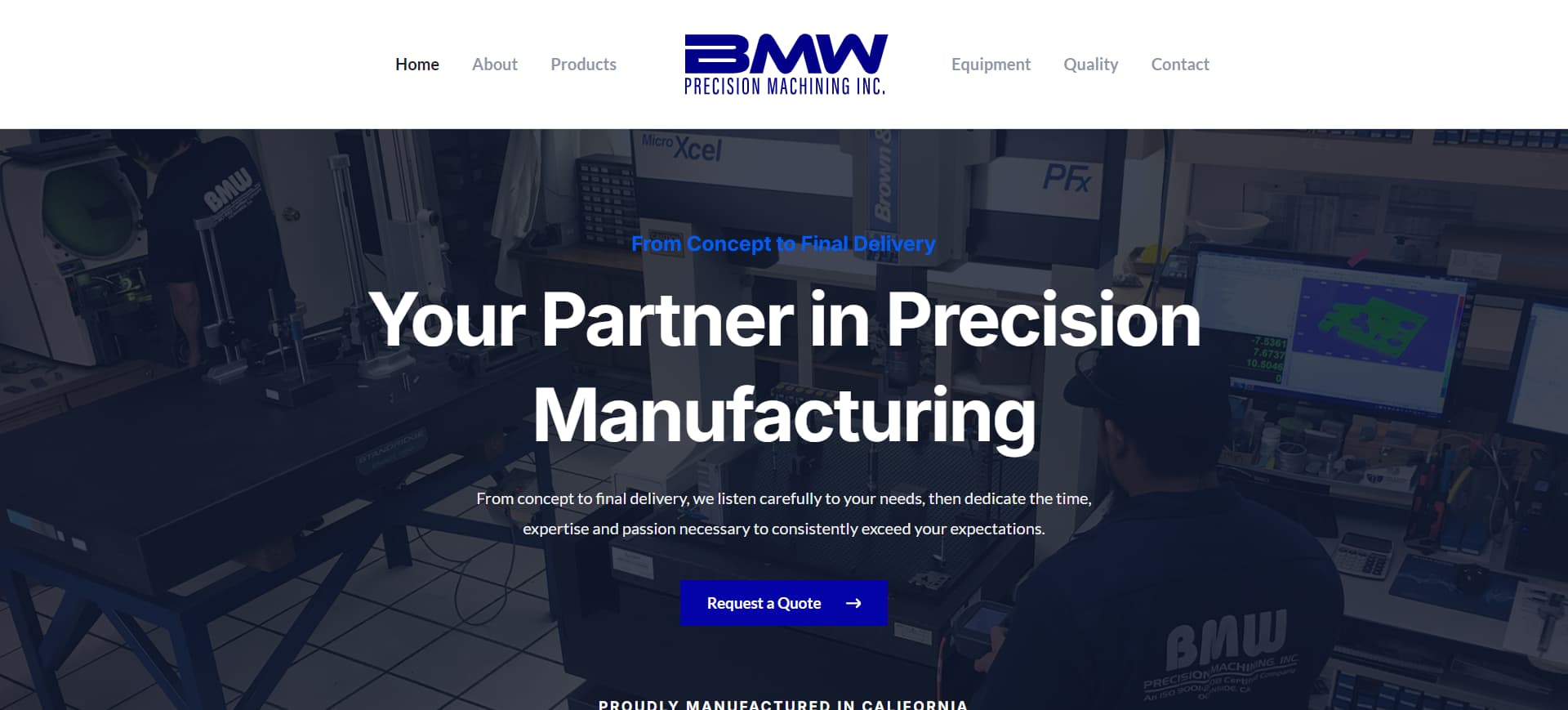
Source: BMW Precision Machining's Official Website (https://www.bmwprecision.com/)
BMW Precision Machining is an American company that uses multiple precision machining devices to provide cutting-based microfabrication services.
This page presents the strengths of Citrogene's microfabrication services, the sizes they can work with, and more.
BMW Precision Machining's microfabrication services
BMW Precision Machinery, founded in 1981, uses the expertise it has accrued through over 40 years of milling to smoothly handle everything from processing to delivery.
It has a highly efficient production system that uses unmanned, automated equipment to mass produce articles with production volumes in the thousands. Thanks to its 3D measurement equipment, it achieves tolerances of ±0.0002 inch (approx. 0.005 mm).
Fabrication services
BMW Precision Machining is capable of mass-production of small-diameter precision components using its Swiss-style automatic lathes and multi-axis simultaneous machining using its CNC lathes.
It produces high-precision finishes of complex shapes, including drilling, threading, cutting, groove formation, and curved surface machining, all with a single chucking.
Supported materials
BMW Precision Machining primarily works with the materials used in metal components used in medical and electronic devices. The specific materials it works with are not noted on its website.
Supported sizes
The diameters supported by its bar and chucker equipment are indicated on its website, but the specific sizes supported vary depending on the equipment used.
For example, in the case of small-diameter bar machines, the maximum processing diameter is 10 mm for the SR-10J Type C, approximately 15.88 mm (5/8 inch) for the Star RNC-16, and approximately 19.05 mm (3/4 inch) for the Star SR20J II.
CHECK Finding Your Partner Based on Processing Style
BMW Precision Machining has an automated inspection system to achieve greater efficiency while maintaining quality levels. This makes it an excellent partner for companies focused on precision component reproducibility and cost efficiency improvements.
It is particularly well-suited for projects with short turnarounds in the medical or electronic device fields, which require high levels of precision.
In addition to BMW Precision Machining, this site introduces many other providers of microfabrication services, categorized by fabrication method. Please use it to help you compare and consider potential microfabrication partners.
Examples of BMW Precision Machining's microfabrication
Not listed on the official website
Company Information
| Company Name |
BMW Precision Machining |
| Location |
2379 Industry Street
Oceanside, CA 92054
USA |
| Telephone |
+1-(760)-439-6813 |
| Website |
https://www.bmwprecision.com/ |