This page presents the features of companies that offer CNC machining services.
Koyo High Precision
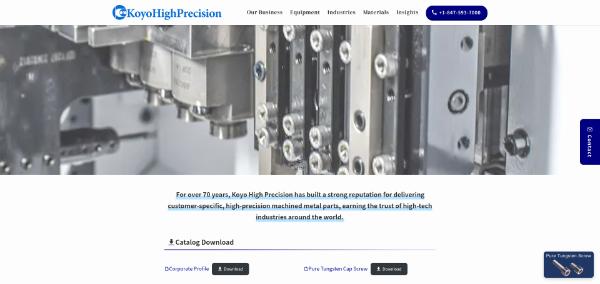
Koyo High Precision supplies microfabrication technologies such as CNC turning for difficult-to-cut materials like tungsten and molybdenum. For typical turning operations, it states that it can consistently maintain a tolerance of ±3 µm in mass production.
It works with difficult-to-machine and specialty materials such as pure tungsten, pure nickel, Inconel, molybdenum, Kovar, oxygen-free copper, stainless steels, pure aluminum, and brass. It also handles on-site processes from cutting to inspection, and its equipment includes CNC lathes, machining centers, grinders, 3D measuring instruments, image inspection machines, and CAD/CAM systems.
CNC Machining Details
Examples and Applications
Koyo High Precision lists machining examples for semiconductor, medical device, optics, vehicle, industrial machinery, and other fields. Examples include MAT21 parts with 5,000 holes, pure tungsten screws, quartz glass hole drilling, SUS316 small-diameter deep-hole drilling, thin-wall tungsten parts, and tantalum components.
Lead Time and Turnaround
The official website does not state a standard lead time for CNC machining. It does state that orders can start from one piece and that the company has experience producing more than one million units per month for certain items, although actual capacity varies by part shape and requirements.
Machining Capabilities and Equipment
The company has approximately 200 CNC lathe machines, 30 machining centers, grinding machines, measuring instruments, and CAD/CAM equipment. Its equipment list includes NC lathes, machining centers, drilling centers, five-axis lathes, six-axis automatic lathes, grinders, 3D measuring instruments, image inspection machines, and CAD/CAM systems.
Materials, Precision, and Quality
Koyo High Precision works with materials such as pure tungsten, pure nickel, Inconel, molybdenum, Kovar, pure silver, oxygen-free copper, iron-based alloys, stainless steels, pure aluminum, and brass. For typical turning operations, it states that it can consistently maintain a tolerance of ±3 microns in mass production.
Runsom Precision provides online CNC machining services for custom parts, rapid prototyping, and production. Its service page lists 3-axis, 4-axis, and 5-axis CNC machining, CNC turning, grinding, EDM, and laser cutting.
The company states that its CNC machining service has a tolerance of ±0.005 mm and ISO 9001 certification. It also lists material options such as aluminum alloys, copper alloys, brass alloys, stainless steel alloys, steel alloys, titanium alloys, and plastics, as well as surface finishes such as bead blasting, anodizing, and powder coating.
Runsom Precision states that it serves fields such as medical, robotics, semiconductor, optics, and petroleum industries.
CNC Machining Details
Examples and Applications
Runsom Precision states that its CNC machining services are trusted by the medical, robotics, semiconductor, optics, and petroleum industries. Its service is positioned for custom parts, rapid prototyping, complex geometries, and full-scale CNC manufacturing.
Lead Time and Turnaround
The company states that it provides free quotes in 24 hours and fast delivery in 3 to 7 days.
Machining Capabilities and Equipment
Runsom Precision provides 3-axis, 4-axis, and 5-axis CNC machining, CNC turning, grinding, EDM, and laser cutting. Its 5-axis machining service is described as suitable for intricate geometries, undercuts, and multi-surface contours in a single setup.
Materials, Precision, and Quality
The company lists aluminum alloys, copper alloys, brass alloys, stainless steel alloys, steel alloys, titanium alloys, and plastics as CNC machining materials. Its CNC machining service page states a tolerance of ±0.005 mm and ISO 9001 certification.
The official Richconn website could not be verified during this review because the page displayed a verification screen instead of accessible company or service content. For that reason, details such as CNC machining examples, lead time, tolerance, equipment, and supported materials should be confirmed directly on the official website or through company materials before being used as verified claims.
CNC Machining Details
Examples and Applications
Official website content could not be verified during this review. CNC machining examples should be confirmed directly with Richconn before publication.
Lead Time and Turnaround
Official website content could not be verified during this review. No official lead time or turnaround information was confirmed.
Machining Capabilities and Equipment
Official website content could not be verified during this review. Equipment details such as 5-axis CNC machines or Swiss-style automatic lathes should not be presented as official information unless confirmed from an accessible Richconn source.
Materials, Precision, and Quality
Official website content could not be verified during this review. Tolerance, surface roughness, material, and quality-control claims should be checked against official Richconn materials before publication.
Baker Industries has multi-axis CNC equipment, including five-axis CNC equipment, and a roughly 65,000-square-foot machining area with temperature, vibration, and access controls. It works with metals, plastics, and some composite materials, and can handle everything from parts and tooling measuring just a few inches to large structures over 100 feet long.
It supplies CNC machining services for demanding fields such as aerospace, defense, automotive, energy, and other industrial applications. It has experience with difficult and specialty materials such as Inconel, Invar, titanium, magnesium, and other exotic materials.
CNC Machining Details
Examples and Applications
Baker Industries describes CNC machining for a wide variety of industries and applications, including large and challenging projects. It states that it machines parts and tooling ranging from just a couple of inches to more than 100 feet long.
Lead Time and Turnaround
The official website does not state a standard CNC machining lead time. It does state that Baker Industries plans and schedules work to meet strict deadlines, especially for complex and large-scale projects.
Machining Capabilities and Equipment
The company operates more than 65,000 square feet of temperature-, vibration-, and access-controlled machining space. Its CNC machining page lists boring, drilling, milling, tapping, turning, threading, and related operations for metal, plastic, and composite materials.
Materials, Precision, and Quality
Baker Industries works with metals, plastics, and some composite materials. It states that it has extensive experience with exotic, difficult, and volatile materials, including Inconel, Invar, titanium, and magnesium. Its CNC machining page also states that the company develops advanced manufacturing solutions for customers' precise tolerance requirements.
Advance CNC is an AS9100-certified and ITAR-registered CNC machining partner for aerospace and defense manufacturers. Its website states that it uses 4-axis and 5-axis CNC machining centers, integrated automation for 24/7 lights-out manufacturing, and just-in-time delivery and custom stocking programs.
Its Swiss CNC machining service is positioned for high-volume production runs of small, intricate parts where precision matters most. Advance CNC also provides CMM and laser inspection services using equipment such as CMM machines, Faro Arms, Keyence machines, Flash, and Scienscope systems.
CNC Machining Details
Examples and Applications
Advance CNC presents cycle-time examples for a mounting head, a 12-inch elbow, and a rotation arm. In those examples, it compares average cycle times with its own cycle times and shows time savings of 82%, 84%, and 74% respectively.
Lead Time and Turnaround
Its 4-axis and 5-axis machining page states that multi-axis machines allow shorter lead times and greater accuracy. Its Stocking Program also states that customers requiring 50 to 50,000 of a single part number can improve lead times and that parts can be shipped the same day they are requested.
Machining Capabilities and Equipment
Advance CNC provides high-speed 4-axis and 5-axis CNC machining, 24/7 production, CNC Swiss machining, and automated production capabilities. Its Swiss CNC machining page describes the process as suitable for high-volume production runs of small, intricate parts.
Materials, Precision, and Quality
The company states that it is AS9100 certified and ITAR registered. Its inspection services page lists 3 CMM machines, 3 Faro Arms, 2 Keyence machines, 1 Flash system, and 1 Scienscope system, and states that its inspection equipment can measure parts to 0.0001 inch.
Jiga manages a manufacturing platform that connects users with vetted machine shops worldwide. Its CNC machining service covers processes such as CNC milling, CNC turning, Swiss lathe machining, micromachining, 5-axis milling, Wire EDM, grinding, honing, and laser part marking.
Everything from quote collection to supplier selection can be handled through the platform. Users can upload CAD files and technical drawings, receive quotes from multiple vetted machine shops, and choose a supplier based on price, lead time, and capabilities. Jiga supports a wide range of materials, including common metals, specialty metals, rare metals, standard plastics, special engineered plastics, and custom materials.
CNC Machining Details
Examples and Applications
Jiga connects customers with vetted machine shops for CNC milling, CNC turning, Swiss lathe machining, micromachining, 5-axis milling, Wire EDM, grinding, honing, laser part marking, and related manufacturing services. Its page states that CNC turning services can support quantities from one part to millions of parts.
Lead Time and Turnaround
Jiga states that quotes from real machine shops usually arrive within hours. It also states that standard CNC machining lead times start at 5 business days, with expedited options available for tighter deadlines.
Machining Capabilities and Equipment
The platform connects users to shops with capabilities ranging from simple drill press machines to advanced 5-axis and 6-axis machining centers. Its technical details list up to 6-axis milling machines, complex turning centers, finishing equipment, and more.
Materials, Precision, and Quality
Jiga lists common metals, specialty metals, rare metals, standard plastics, special engineered plastics, and custom materials. Its CNC machining page lists tolerance of ±0.001 inch and quality documentation such as CoC, FAI, CMM reports, material test reports, material certificates, and RoHS documentation.
Miller CNC combines three-axis CNC milling machines, five-axis CNC milling machines, and CNC lathes to machine difficult-to-cut materials such as Inconel, titanium, stainless steel, carbon steel, and exotic alloys. Its CNC turning service page states that its turning process can support high throughput rates and tight tolerance diameters and surface finishes. Based on a foundation of machining for aerospace, defense, space, energy, and industrial manufacturing companies, it supplies mission-critical components with a focus on hard metal and complex machining.
CNC Machining Details
Examples and Applications
Miller CNC describes work for aerospace, defense, space, energy, and industrial manufacturing companies. Its site also lists CNC milling applications such as fuel valves, hydraulic actuators, pressure control units, and shafts, and shows an example part labeled as a stainless complex aircraft fuel valve component.
Lead Time and Turnaround
The official website does not state a standard CNC machining lead time. It does state that its automated CNC machining capabilities help optimize cycle time by completing required machining processes in a single fixture, reducing production time, labor, and setup costs.
Machining Capabilities and Equipment
Miller CNC uses 3-axis mills, 4-axis mills, 5-axis mills, and CNC lathes. Its equipment examples include Haas, Doosan, and Hermle machining centers, and its 5-axis process is described as suitable for machining multiple sides of a component from a single fixture.
Materials, Precision, and Quality
The company primarily machines Inconel, titanium, stainless steel, carbon steel, and exotic alloys in production lot sizes of 50 to 1,000 pieces. It states that it is AS9100- and ISO9001-certified, and its CNC machining cost FAQ states that pricing can range from $50 to $500 per hour depending on factors such as material, machine center, and quantity.
TFG USA combines three-, four-, and five-axis CNC machining, EDM, Swiss machining, and other CNC manufacturing techniques to perform high-precision manufacturing of small, complex components used in medical devices, electronics, industrial equipment, and oil and energy applications. One of its features is its ability to work with tight tolerance requirements across industry-specific projects.
It manages quality with a system based on ISO 9001 and AS9100, and its inspection processes include Coordinate Measuring Machines and laser inspections.
CNC Machining Details
Examples and Applications
TFG USA describes CNC machining applications for medical devices, electronics, industrial equipment, and oil and energy. Examples include surgical instruments, implants, electronic enclosures, connectors, heavy machinery components, pumps, valves, valve bodies, manifolds, pump housings, and drilling equipment components.
Lead Time and Turnaround
The official website does not state a standard CNC machining lead time. It does state that 5-axis machining, EDM, and Swiss machining can reduce lead times while maintaining precision and quality.
Machining Capabilities and Equipment
TFG USA lists 3-axis, 4-axis, and 5-axis milling machines, as well as advanced CNC manufacturing techniques such as 5-axis machining, EDM, and Swiss machining. It describes these capabilities as suitable for small, intricate components with tight tolerances.
Materials, Precision, and Quality
The company lists materials such as 12L14 steel, alloy steel, aluminum, brass, carbon steel, copper, duplex, Inconel 718, Monel, stainless steel, titanium, and tool steels. It states that it is certified under ISO 9001 and AS9100 and uses Coordinate Measuring Machines and laser inspections for quality control.
First, clarify which types of processing you would like to request, and then confirm their processing precision, the number of axes of their machines, and the types of materials they work with. Different companies have different fields of expertise depending on their equipment configurations, such as three-axis machining, five-axis machining, Swiss machining, EDM, and CNC turning, so it is important to determine whether their capabilities match your design requirements.
Next, confirm their tolerance management systems, inspection systems, and quality assurance frameworks, including ISO certification, to determine whether they can maintain stable quality. Before getting an estimate, clearly indicate tolerances, material quality, surface processing, lot size, and required turnaround time in your drawings or inquiry materials. This helps prevent misunderstandings and makes future dealings progress more smoothly.
FAQ About Choosing a CNC Machining Company
What is the difference between 3-axis, 4-axis, and 5-axis CNC machining?
Axis count is how many directions the tool can move or the part can rotate. 3-axis machining covers most prismatic parts. 4- and 5-axis machining reach complex contours, undercuts, and multiple faces in fewer setups, which improves accuracy and surface quality. Match the axis count to your geometry: simple parts rarely need 5-axis, but complex contoured parts usually do.
What is the difference between CNC milling and CNC turning?
Milling uses a rotating tool to cut a fixed workpiece, which suits flat faces, pockets, and complex shapes. Turning spins the workpiece against a stationary tool, which suits round parts like shafts, pins, and bushings. Many parts need both, and some shops combine them in mill-turn machines.
What tolerances can CNC machining hold?
Standard CNC tolerances are around ±0.1 mm (ISO 2768). Precision shops hold tighter bands, often down to ±0.005 mm on critical features. Tighter is not automatically better: halving a tolerance can double or quadruple cost, so reserve tight tolerances for features that truly need them.
Can CNC machining companies handle exotic materials like Inconel, titanium, or tungsten?
Yes, but not every shop. Hard alloys and difficult-to-cut materials work-harden, wear tooling fast, and demand high-torque spindles, rigid setups, and specific machining strategies. Confirm the shop has direct experience with your exact material rather than just listing it as supported.
How much does CNC machining cost?
There is no flat rate, but you can anchor on machine time: published shop rates often run from roughly $50 to $500 per hour depending on material, machine, and complexity. Setup is a fixed cost spread across the batch, so unit price drops sharply as volume rises, while tight tolerances and fine finishes raise it the fastest. Use the hourly range for a rough sense of scale, then get a real quote from a complete RFQ for anything you plan to order.
How long does CNC machining take?
Lead time varies by part and shop. Some online services turn around low-volume aluminum or plastic parts in 3 to 7 days, while production runs, material sourcing, finishing, and inspection add time. State any hard deadline in your RFQ, since many shops offer standard and expedited options.
What certifications should I look for in a CNC machining company?
Tie certifications to your industry. ISO 9001 covers general quality management, AS9100 is expected for aerospace and defense, ITAR registration applies to export-controlled defense work, and ISO 13485 applies to medical devices. In a regulated field, treat the relevant certification as a filter rather than a bonus. The real risk of using an uncertified shop shows up after delivery: when your own compliance audit or notified body asks for documentation the shop cannot produce, the parts may be unusable no matter how well they were machined.
How do I know a shop can actually hold the tolerances it claims?
Ask how they verify parts, not just what tolerance they quote. The most revealing questions are direct: What tolerances do you hold in routine production? Can you share a sample inspection report? What are your typical quality escape rates? A shop with strong metrology answers these comfortably and can provide CMM reports, first article inspection (FAI), and material certifications. Hesitation or vague answers on inspection is a red flag for tight-tolerance or mission-critical work.
Can one company handle both prototypes and production volume?
Some shops are built for prototypes and low volume, others for sustained runs. If you need one prototype now and thousands of parts later, confirm the shop can scale without retooling delays or subcontracting your work. Ask directly about typical lot sizes and whether they offer stocking or just-in-time programs for repeat orders.
How can I tell during quoting whether a shop will actually support my design?
The quote itself is the test. A shop that supports you reviews the design for manufacturability (DFM) and comes back with questions or suggestions: loosen this non-critical tolerance, swap this alloy, adjust this thin wall to cut cost or risk. A shop that simply returns a price with no comment is quoting exactly what you sent and pricing in the uncertainty. Early DFM feedback is the clearest signal you will get good engineering support later.
Should I choose a U.S.-based shop or an overseas supplier?
It depends on what the part demands. Overseas shops in regions like China often win on unit price for larger volumes, but add shipping time, customs, and longer communication loops, and they cannot handle ITAR-controlled defense work. Domestic shops typically offer faster turnaround, easier collaboration, and simpler IP and export-control handling, which matters most for prototypes, tight deadlines, regulated industries, and sensitive designs. For high-volume, non-sensitive parts where cost dominates, overseas sourcing can make sense; for everything else, proximity usually pays off.
Should I use an online manufacturing platform or order from a shop directly?
Platforms that connect you to a network of vetted shops are useful when you want fast quotes, broad capability coverage, or a single source for varied parts, since you upload a file and compare options quickly. Ordering directly from a specific shop tends to work better for ongoing production, specialized materials, or parts where you want a long-term relationship and direct engineering dialogue. Many buyers use platforms to source prototypes and one-offs, then move to a direct relationship once a part goes into repeat production.
What should I prepare before requesting a quote?
Send a complete package so the shop quotes without guessing: a 3D CAD model (STEP file), a 2D drawing (PDF) with tolerances, GD&T, and surface finish, the exact material grade and condition (for example, Aluminum 6061-T6), your quantity and any annual estimate, required certifications and inspection documents, and a deadline if it is firm. Missing details lead shops to add a risk premium or pause for clarification.
Do I need a 2D drawing if I already have a 3D CAD file?
Yes. The 3D model defines geometry, but the 2D drawing carries what the model cannot: tolerances, GD&T, surface finish, and notes. A threaded hole, for example, often appears as a plain cylinder in a STEP file and will be machined as a smooth hole without a drawing to specify the thread.
How should I specify tolerances to keep costs down?
Set a general tolerance for non-critical dimensions, then flag only the features that truly need precision, usually three to five critical-to-function dimensions with their datums. Applying tight tolerances everywhere forces the shop to price for the tightest interpretation and inflates the quote.
[Choose by Fabrication Type] Top Three Recommended Microfabrication Partners
For difficult-to-cut materials
Koyo High Precision
Source: Koyo High Precision website (https://koyohighprecision.com/)
Examples of supported materials
Tungsten, molybdenum, tantalum,etc.
Main fabrication technologies
Micro drilling
Lathe machining
Milling
Why We Recommend
They perform fabrication for a wide range of sizes, from ⌀3 to 220 mm,and they can handle everything from prototype development to mass production fabrication for difficult-to-cut materials
They can achieve a fabrication precision of ±3 μm even for tungsten,which is known for being difficult to cut.