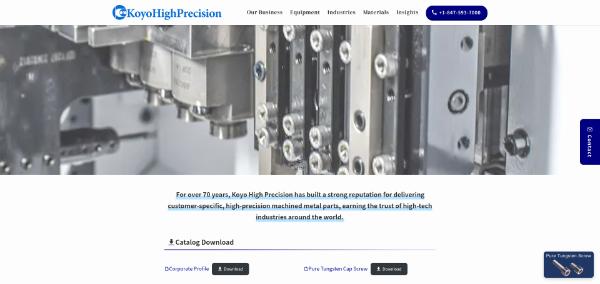
Micro milling services are a good fit when a part has tiny features, thin walls, sharp edges, or tight tolerance requirements that a standard CNC machining supplier may not be able to control consistently. The key question is not just whether a supplier can machine small parts. It is whether they can manage the material behavior, part geometry, inspection process, and repeatability required to make those parts reliably.
- Micro milling is a precision machining process used to produce small mechanical features and micro-scale geometries.
- The right process depends on material, feature size, tolerance, surface finish, and inspection requirements.
- Micro milling is different from general micromachining, micro EDM, laser machining, and pavement micro-milling.
- A qualified supplier should explain process limits, inspection methods, and design risks before production begins.
- When sourcing in the U.S., compare providers by application and capability, not by the word “micro” alone.
What Are Micro Milling Services?
Micro milling is a precision machining process that removes material using extremely small cutting tools. It is used to create micro-scale features, fine slots, miniature holes, thin walls, sharp edges, and detailed 3D geometries that are difficult to produce with conventional milling.
Compared with standard CNC milling, micro milling depends much more on tool runout control, spindle stability, vibration management, thermal control, and high-resolution inspection. At this scale, even slight tool deflection or thermal movement can affect the finished part.
- Micro milling
- A mechanical material-removal process that uses miniature cutting tools. It is best understood as a specific type of precision cutting.
- Micromachining
- A broader category that may include micro milling, micro turning, EDM, laser machining, Swiss machining, grinding, or lithography-based processes.
It is also important to distinguish industrial micro milling from pavement micro-milling. In manufacturing, micro milling refers to precision machining for small parts and micro-features, not road surface milling.
When Micro Milling Is the Right Choice
Micro milling is a strong choice when a part requires small mechanical features that must hold their shape, edge quality, and dimensional accuracy. Common use cases include microfluidic channels, miniature molds, medical device components, optical parts, micro gears, nozzles, connectors, and precision fixtures.
Choose micro milling when the part requires:
- Clean edges on small features
- Fine surface control
- Tight dimensional accuracy
- Micro slots, holes, walls, or contours
- Repeatable features across multiple parts
- Lower risk of heat-affected zones or recast layers
That said, micro milling is not always the best process. Micro EDM may be a better option for very hard conductive materials, deep narrow features, or internal corners that are difficult to cut mechanically. Laser machining may be more suitable when non-contact processing, very small holes, or thin material processing is more important than a machined surface finish.
The right supplier should help you choose the process based on the part requirements instead of forcing every project into milling.
Key Capabilities to Check Before Choosing a Micro Milling Service
The most important question is not “Can this company machine small parts?” It is “Can this company control the process at the scale my part requires?”
Technical capabilities to check first
- Achievable tolerances and repeatability
- Minimum tool diameter and feature size
- Spindle speed, runout, and vibration control
- Workholding for small or fragile parts
- Experience with your material
- Burr control and surface finish capability
- Inspection methods for micro-scale features
- Prototype and production support
Inspection is especially important. A micro-milled feature may be too small to verify with standard measuring tools. Look for suppliers that can explain how they measure small features, surface finish, part alignment, and critical dimensions.
Also ask how they provide design feedback. A strong micro milling partner will flag risk areas before machining begins, such as features that are too deep for the tool diameter, tolerances that may add unnecessary cost, or material choices that could increase burrs or tool wear.
Materials Commonly Used in Micro Milling
Micro milling can be used with a wide range of materials, but machining difficulty varies significantly depending on hardness, ductility, thermal behavior, and edge-quality requirements.
| Material group | Examples | What to watch for |
|---|---|---|
| Medical and structural metals | Stainless steel, titanium, medical-grade metals | Tolerance, surface finish, burr control, traceability, and inspection |
| Conductive alloys | Aluminum, brass, copper, and related alloys | Copper and other soft alloys may create burr-control or chip-control challenges |
| Difficult-to-machine metals | Tungsten, molybdenum, Inconel, Hastelloy, and similar materials | Tool wear, slower cutting parameters, heat control, and supplier experience |
| Engineering plastics | PEEK, PTFE, Delrin, Ultem, and other rigid plastics | Heat, deformation, workholding, and dimensional stability |
| Specialty substrates | Ceramics, glass, quartz, and specialty materials | Chipping, cracking, edge condition, and process suitability |
Common Applications for Micro-Milled Parts
Micro milling is used in industries where even very small components must perform reliably under strict dimensional or functional requirements.
- Medical and diagnostics
- Surgical tools, implants, diagnostic components, small channels, and precise mechanical features.
- Aerospace and defense
- Satellite components, sensors, precision housings, nozzles, and lightweight miniature parts.
- Electronics and semiconductors
- Connectors, housings, semiconductor-related parts, and precision fixtures.
- Optics and microfluidics
- Optical parts, microfluidic channels, photonics-related components, molds, and precision tooling.
These applications often share the same challenge: the part is small, but the risk is not. A tiny defect can affect flow rate, alignment, electrical contact, sealing performance, optical function, or assembly yield.
How to Compare Micro Milling Companies in the U.S.
When comparing providers, start with the part’s requirements rather than the supplier’s marketing language. Many companies use terms like “precision,” “micro,” or “tight tolerance,” but those terms do not always mean the same thing.
1. Match the provider to your material
Experience with your exact material matters more than a long list of supported materials.
2. Confirm the smallest feature and tolerance
Ask whether the supplier can both machine and inspect the smallest feature on your drawing.
3. Check related process options
For some features, EDM, grinding, Swiss machining, laser machining, or hybrid processing may be a better fit.
4. Review quality and documentation requirements
Certifications, inspection reports, traceability, and repeatability become especially important when the part is regulated or ready for production.
Recommended Micro Milling and Microfabrication Partner Types by Use Case
If you are sourcing micro milling services in the U.S., start with the project’s main challenge. The best provider for a tungsten component may not be the best provider for a MEMS device, a microfluidic part, or a high-volume precision component.
| Best fit | What to look for | Good for |
|---|---|---|
| Difficult-to-machine metals | Experience with tungsten, molybdenum, titanium, Inconel, Hastelloy, or similar materials | Semiconductor equipment parts, nozzles, and precision metal components |
| MEMS and semiconductor-related parts | Microfabrication capabilities beyond milling, such as etching, photolithography, wafer processing, or hybrid processes | MEMS, photonics, sensors, and wafer-level components |
| Complex precision machining | Engineering review, inspection capability, and support for both prototypes and production | Small mechanical parts, fixtures, medical components, and aerospace components |
| Micro holes, slots, and fine internal features | Ability to evaluate micro milling alongside EDM, laser processing, drilling, or grinding | Microfluidics, connectors, nozzles, and fine channels |
| Production-ready micro parts | Repeatability, quality systems, lot-to-lot control, and inspection documentation | Repeat orders, regulated parts, and supply chain programs |
The most useful question is “Which company is best for this material, this geometry, and this production goal?”
What to Prepare Before Requesting a Quote
A better RFQ leads to a more useful response. Before contacting a micro milling service provider, prepare as much of the following information as possible.
RFQ checklist
- 3D CAD data
- 2D drawings with critical dimensions
- Tolerance requirements
- Material grade and acceptable alternatives
- Surface finish requirements
- Burr, edge, cleaning, or contamination requirements
- Target quantity and expected repeat orders
- Inspection report requirements
- Compliance requirements
- Target lead time
If you are not sure whether a tolerance is necessary, ask the supplier. Overly tight tolerances can increase cost and lead time, while unclear tolerances can result in parts that are technically machined but not usable.
Micro milling is only one option within precision microfabrication. If your part involves difficult-to-machine materials, microcomponents, semiconductor-related parts, or surface processing, compare suppliers by supported process, material experience, inspection capability, and production fit.
Use the processing-type comparison to narrow down which kind of partner is likely to match your project before requesting a quote.
FAQ About Micro Milling Services
- What tolerances are realistic for micro milling?
- Realistic tolerances depend on the material, feature size, part geometry, machine stability, workholding, and inspection method. Some suppliers can work to micron-level tolerances, but that does not mean every feature in every material can be held to that level.
- Is micro milling only for prototypes?
- No. Micro milling can be used for prototypes, low-volume production, and repeat production. The key question is whether the supplier can maintain consistency across parts and lots.
- What materials are hardest to micro mill?
- Hard alloys, gummy metals, brittle materials, and heat-sensitive plastics can all be challenging. Tungsten, molybdenum, Inconel, Hastelloy, titanium, copper, ceramics, and certain polymers may require specialized tooling and process control.
- How much do micro milling services cost?
- Cost depends on the material, feature size, tolerance, surface finish, inspection requirements, quantity, and setup complexity. A small part is not always inexpensive if it requires specialized tooling, slow machining, or advanced measurement.
- How do I know if my part needs micro milling or another process?
- Start with the feature geometry, material, tolerance, and edge-quality requirements. Micro milling is useful for precise mechanical features and fine surface control, but EDM, laser machining, Swiss machining, grinding, or lithography-based processes may be a better fit for certain shapes or materials.