Viant Medical Precision Machining
Open Table of ContentsClose Table of Contents
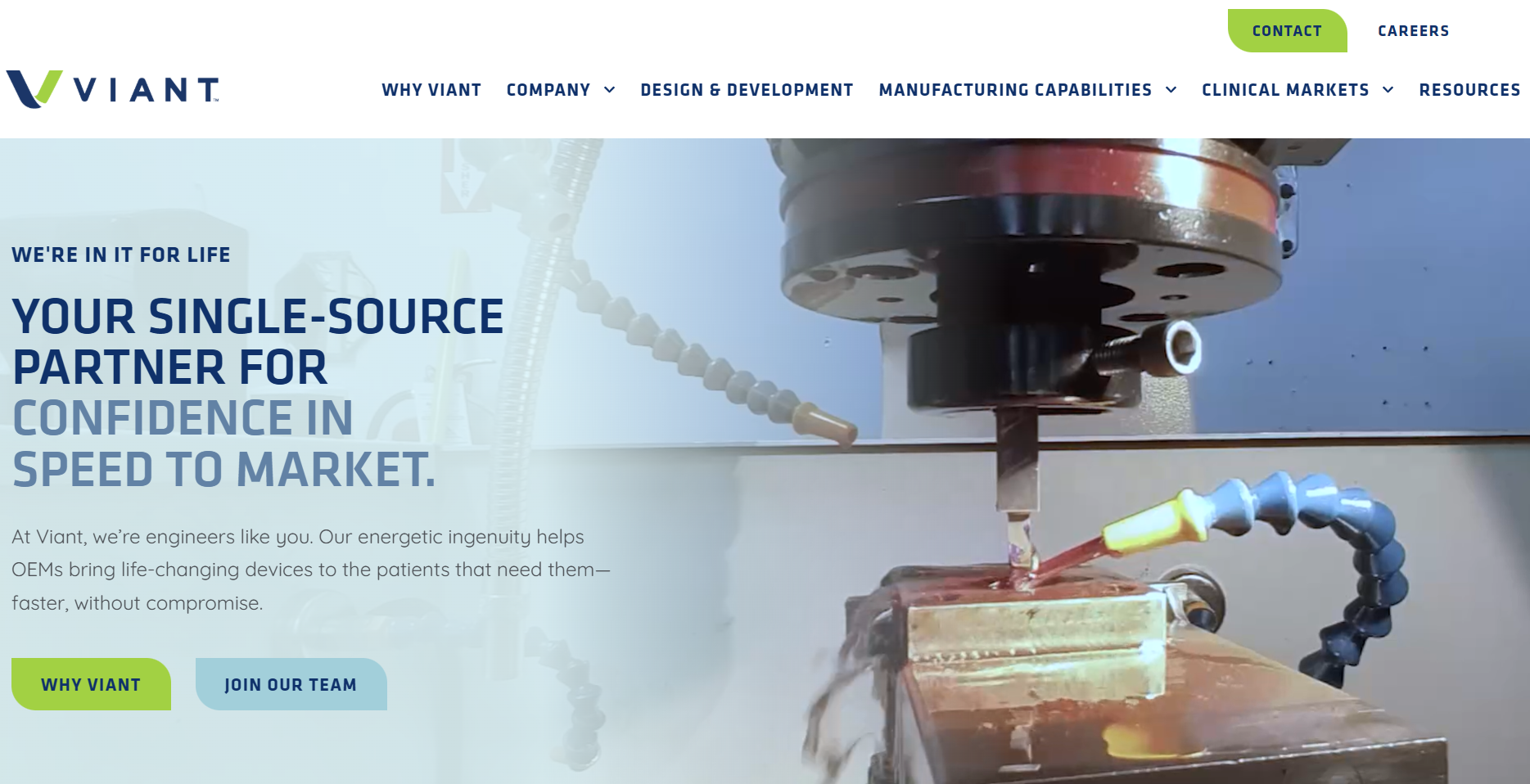
Source: Viant Medical's Official Website (https://viantmedical.com/)
Medical device OEMs evaluating precision machining partners need more than a list of machines. The right supplier should be able to produce complex components, support manufacturability decisions, manage secondary processes, and understand the quality expectations that come with regulated medical devices.
Viant Medical is often reviewed in this context because the company lists a broad range of medical metal manufacturing and tooling capabilities. Its capabilities include high-tolerance machining, fabrication, welding, finishing, testing, and quality assurance. Its tooling information also covers DFM/DFX, CAD/CAM, mold flow analysis, process development, and production transition support.
This article summarizes what Viant Medical presents publicly, where its capabilities can support supplier comparison, and which points buyers should clarify before requesting a quote.
Key Takeaways for Supplier Evaluation
- Viant Medical is most relevant to buyers evaluating precision machining in a medical device manufacturing context, rather than general-purpose industrial machining.
- Listed machining capabilities include CNC milling and turning, Swiss and Laser Swiss machining, multi-axis and ID/OD grinding, and Wire EDM / Conventional EDM.
- Its tooling capabilities are connected to manufacturability support, including DFM/DFX, CAD/CAM, 2D and 3D design, mold flow analysis, process development, and production transition.
- Before shortlisting Viant Medical, buyers should clarify project-specific requirements such as tolerances, materials, expected volumes, inspection needs, and manufacturing location.
Core Precision Machining Capabilities
Viant Medical’s machining profile centers on high-tolerance medical metal components. The value for buyers is that these processes are presented within a medical device manufacturing environment that also includes finishing, testing, materials support, and quality assurance.
Machining processes listed by Viant Medical
Viant Medical identifies several high-tolerance machining capabilities for complex medical components:
- CNC milling and CNC turning
- Swiss and Laser Swiss machining
- Multi-axis grinding
- ID/OD grinding
- Wire EDM and Conventional EDM
These processes are especially important when a project involves tight geometry, small or complex metal components, or parts that need to move from prototype requirements into a controlled production workflow.
Related metal fabrication capabilities
Viant Medical also lists adjacent metal fabrication capabilities that can matter when a machined component requires additional processing before it is production-ready.
- Medical-grade metal tubing fabrication
- Medical sheet metal fabrication
- Laser cutting
- Gun drilling
- Knurling
These capabilities should be reviewed as part of the broader sourcing picture. If a part requires machining along with tubing work, laser processing, or other fabrication steps, keeping those steps within a coordinated manufacturing program can help reduce handoff risk.
Example component types
Viant Medical lists components and device-related parts used across surgical, orthopedic, and interventional applications.
| Component or product type |
Why it matters in supplier comparison |
| Drive shafts |
May require dimensional consistency, material control, and integration with a larger device assembly. |
| Burrs and drills |
Often require precise geometry, repeatability, and appropriate finishing for surgical use. |
| Anchors and bone screws |
Can involve demanding material, surface, and quality requirements in orthopedic applications. |
| Cutting guides |
May require tight dimensional control and reliable repeatability across production lots. |
| Trocars, retractors, and reamer handles |
Show relevance to surgical instruments and procedure-specific device components. |
| Stent delivery components |
Point to applications where small, precise metal components must support interventional device performance. |
What to clarify for machining projects
Public capability information is useful for initial screening, but project fit depends on the actual RFQ requirements. Buyers should clarify the required tolerance range, material grade, part size, annual volume, secondary operations, inspection method, documentation needs, and manufacturing location.
Precision Tooling and DFM Support
Viant Medical’s tooling support is most useful when a medical device project needs manufacturability input before tooling and production decisions are finalized. Its tooling capabilities cover tool design, DFM/DFX, CAD/CAM, 2D and 3D design, mold flow analysis, process development, and mold types such as multi-shot, insert, and multi-cavity molds.
Tooling support for manufacturable device designs
For medical device OEMs, tooling decisions can affect part consistency, validation planning, production uptime, and long-term part cost. Early DFM/DFX input can help identify moldability, material behavior, geometry, and process risks while the design is still flexible enough to adjust.
From tool development to production transition
Viant Medical describes tooling as a process that connects design analysis, qualification, validation, and manufacturing. Buyers should clarify how Viant supports tool qualification, First Article Inspection, capability data review, and the handoff from tooling into routine production.
What to clarify for tooling projects
Key items include the expected mold type, cavity strategy, target production volume, material requirements, tool ownership terms, maintenance expectations, validation deliverables, and whether fabrication, service, and lifecycle management are handled through Viant facilities or supplier partners.
Medical Device Applications and Component Types
Viant Medical presents its precision machining and tooling capabilities for medical device programs where metal component performance, repeatability, and production control matter. Its stated application areas include orthopedic, surgical, interventional, drug delivery, and bioelectronic device categories.
Clinical markets referenced by Viant Medical
Viant Medical identifies several clinical markets where its metal manufacturing and device manufacturing capabilities apply:
- Orthopedics
- Surgical technology
- Cardiac and interventional devices
- Drug delivery
- Bioelectronics
These categories help buyers narrow the initial fit check. A supplier with experience in a relevant clinical market is better prepared to discuss part function, material constraints, quality expectations, and production documentation during the RFQ process.
Examples of product and component areas
Viant Medical’s examples cover both implantable and instrument-related components. Buyers should use these examples as screening references, then verify whether the specific part geometry, material, tolerance, and documentation requirements match their own program.
| Application area |
Examples referenced in public information |
What buyers should evaluate |
| Orthopedic implants and instruments |
Bone screws, anchors, cutting guides, burrs, drills, and reamer handles |
Material requirements, surface finish, dimensional control, and inspection documentation |
| Surgical and minimally invasive devices |
Trocars, retractors, arthroscopic devices, laparoscopic devices, and robotic-assisted surgery devices |
Component geometry, repeatability, assembly interface, and production scalability |
| Cardiac and interventional devices |
Stent delivery components and laser-cut hypotubes |
Small-part precision, tubing requirements, process control, and secondary operations |
| Drug delivery and bioelectronic devices |
Device-related components for regulated medical applications |
Material compatibility, manufacturing route, quality system expectations, and documentation needs |
How to use application information in supplier comparison
When comparing Viant Medical with other precision machining or tooling companies, buyers should ask whether the supplier has handled similar component functions, materials, production volumes, and regulatory documentation expectations. That discussion is more useful than simply matching a part name to a public example list.
Materials, Finishing, and Quality Considerations
Viant Medical lists experience with stainless steels, titanium and titanium alloys, Nitinol, cobalt alloys, and specialty alloys. For buyers, the key step is to verify experience with the exact material grade required for the device, not just the broader material category.
The company also identifies finishing and secondary processes such as polishing, electropolishing, passivation, heat treating, anodizing, laser marking, and welding. These steps should be reviewed early because surface condition, marking, joining, and treatment requirements can affect product performance, traceability, and validation planning.
Viant Medical also references SEM/EDS, metrology, mechanical testing, and ISO 13485-certified quality systems. Before requesting a quote, buyers should clarify inspection methods, documentation needs, and whether required finishing or testing steps are handled directly by Viant Medical or through qualified partners.
Manufacturing Support Beyond Machining
Support from design input to production transfer
Viant Medical connects design and development, process control, program management, automation, and production transfer around medical device manufacturing programs. This matters when a precision-machined component must move from early technical requirements into a controlled production workflow.
Program coordination across manufacturing stages
Buyers should clarify how prototype requirements are transferred into production, which services are handled at the relevant Viant facility, and how work is coordinated across sites or partners. This section focuses on workflow continuity rather than repeating the machining or tooling capability list.
When Viant Medical Fits the Comparison List
Viant Medical is strongest as a comparison target when a project requires medical metal components, tooling input, finishing, testing, and production planning to work together. Buyers with isolated, low-complexity machining needs may not require this level of manufacturing support.
Projects involving medical-grade metal components
Viant Medical belongs in the comparison set for orthopedic, surgical, interventional, drug delivery, or bioelectronic device programs that require precision-machined metal parts. The comparison should focus on the component function, material grade, tolerance target, and documentation expectations of the project.
Programs that need early manufacturability input
Viant Medical also fits projects where the part design, tooling strategy, and production route need to be considered before the RFQ stage is finalized. Buyers should clarify how early Viant can support DFM/DFX, tooling decisions, process development, and production transfer planning.
Points to Confirm Before Requesting a Quote
RFQ decisions should be based on project-specific technical and commercial requirements, not only on a supplier’s published capability list. Buyers should prepare the following details before asking for a quote.
Technical requirements
- Part drawings, 3D models, and revision history
- Required tolerances and critical-to-quality dimensions
- Material grade and any approved material specifications
- Surface finish, heat treatment, marking, or joining requirements
- Inspection method, sampling plan, and documentation needs
Production and sourcing requirements
- Prototype, pilot, and production volume expectations
- Tooling ownership, maintenance, and lifecycle expectations
- Target production location or supply chain requirements
- Validation, traceability, and change-control expectations
- Program management needs after machining or tooling begins
CHECK Finding Your Partner Based on Processing Style
Viant Medical supports precision machining and tooling for medical device manufacturing, including metal component machining, finishing, testing, and production transfer support. This manufacturer is suited for projects that require medical-grade metal components and a controlled path to production readiness.
It works with materials such as stainless steels, titanium alloys, Nitinol, cobalt alloys, and specialty alloys.
Medical device components often require dimensional control, surface finishing, traceability, and inspection documentation. Choosing a supplier that supports these requirements across machining and production stages can help reduce handoff risks.
This site introduces microfabrication services by processing method, including those offered by Viant Medical.
Use it to find partners that match your processing requirements, materials, and medical device manufacturing needs.
Company Information
| Company Name |
Viant Medical |
| Location |
2 Hampshire Street, Foxborough, MA 02035, United States |
| Official Website |
https://viantmedical.com/ |