Resonetics
Resonetics Microfabrication and Micromachining Services
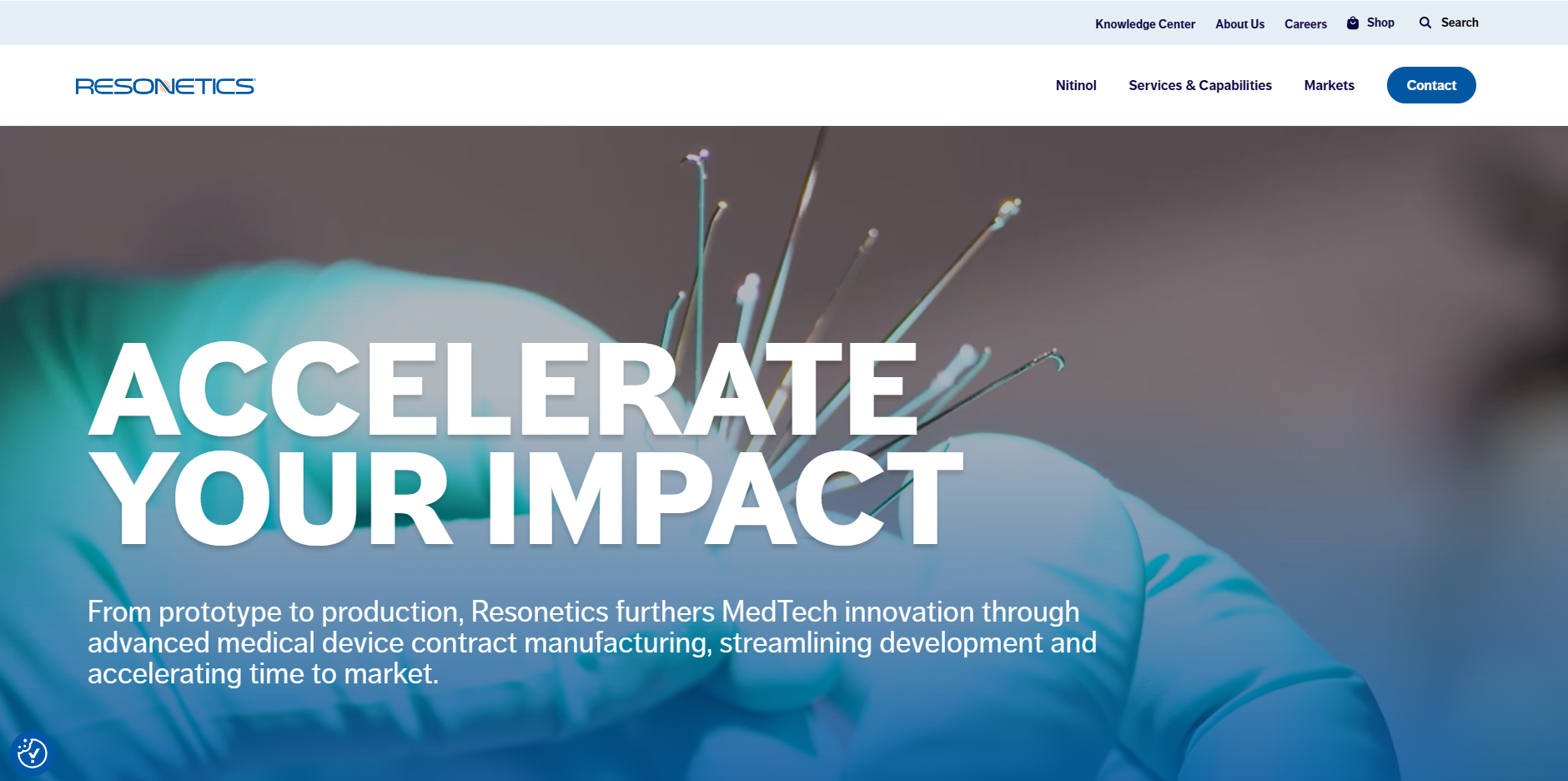
Source: Resonetics Official Website (https://resonetics.com/)
Resonetics provides microfabrication and micromachining services for MedTech and life sciences companies developing small, precision components for complex devices. Its capabilities include laser processing, nitinol processing, and metal fabrication, as well as microfluidic laminates, sensor technology, medical power solutions, and custom laser systems.
Resonetics may be a strong candidate for teams developing minimally invasive devices, diagnostic tools, catheter systems, implants, sensors, and microscale assemblies. The company combines specialized process expertise with support spanning early-stage development through production.
Key Takeaways
- Resonetics specializes in micro manufacturing for MedTech and life sciences applications, including components, subassemblies, and complete devices.
- Its core capabilities include laser processing, nitinol processing, CNC machining, photochemical machining, microforming, micro waterjet cutting, EDM, and related metal fabrication processes.
- The company is best suited to projects that require precision manufacturing, process development, and a scalable path to production rather than straightforward, one-off machining.
- Before shortlisting Resonetics, confirm material compatibility, tolerance requirements, inspection needs, cleanroom requirements, post-processing needs, and expected production volumes.
Resonetics Capabilities at a Glance
Resonetics serves medical device and life sciences manufacturers through a broad portfolio of specialized capabilities. Its services cover raw materials, nitinol processing, laser processing, metal fabrication, microfluidic laminates, sensor technology, medical power solutions, and custom laser systems.
For companies evaluating microfabrication providers, the most relevant capabilities include laser processing, nitinol processing, and metal fabrication. These processes support miniature components that require tight dimensional control, precise feature creation, and careful material handling.
Resonetics also works across multiple stages of product development. According to its official materials, the company supports projects from early-stage prototyping through full-scale production, helping reduce handoffs between product development, process engineering, and manufacturing.
Core Microfabrication Capabilities
Laser Processing
Resonetics applies laser processing to complex medical devices, components, and implants. Its core capabilities include laser cutting, welding, drilling, ablation, and perforation.
Laser processing is particularly useful for parts that require small features, high precision, minimal mechanical contact, or controlled heat input. Resonetics also designs and builds custom laser processing systems in-house, allowing processes to be configured for specific applications.
Potential applications include laser-cut tubing, catheter delivery components, stents, and implants, as well as polymer and glass components that require fine holes, slots, patterns, or selective material removal.
Nitinol Processing
Nitinol is commonly used in medical devices because of its shape-memory and superelastic properties. Resonetics offers nitinol processing capabilities that include laser cutting, laser welding, 3D laser micromachining, shape setting, oxide removal, and electropolishing, as well as EDM, CNC machining, braiding, and chemical etching.
Nitinol projects often require precise control of processing parameters because heat, mechanical processing, and finishing can affect the material’s behavior. Resonetics may be well suited to projects that require both nitinol expertise and microscale processing capabilities.
Typical applications include guidewires, catheter components, stents, and heart valve components, as well as other devices where flexibility, fatigue resistance, and dimensional consistency are critical considerations.
Metal Fabrication and Micromachining
Resonetics’ metal fabrication capabilities include centerless grinding, CNC machining, and photochemical machining, along with microforming, micro waterjet cutting, electropolishing, shape setting, and EDM.
These processes support the production of custom, small-scale medical device components. Resonetics’ CNC capabilities include EDM, Swiss machining, turning, and multi-axis milling, enabling process selection based on part geometry, material, tolerances, and production requirements.
For thin-sheet metal components, photochemical machining can produce complex, burr-free parts through selective masking and chemical etching. For intricate precision components, micro waterjet cutting can create smooth, taper-free sidewalls without introducing thermal or mechanical damage.
Projects That May Be a Good Fit for Resonetics
Resonetics may be worth considering when a project involves miniature medical components, complex geometries, or challenging material behavior, particularly when the product must progress from development into production with fewer supplier handoffs.
The company is particularly relevant to microscale medical device components that require precision manufacturing and specialized process development.
- Minimally invasive medical device components
- Catheter and delivery system components
- Nitinol components and implants
- Stents and structural heart components
- Laser-cut tubing and precision tubular components
- Microscale metal, polymer, or glass features
- Microfluidic laminates and lab-on-a-chip devices
- Miniaturized sensors and sensor-integrated subassemblies
Resonetics may be less appropriate for a standard, low-complexity machined part that does not require specialized microscale processing, medical device expertise, or process development.
Microfabrication Process Strengths
Precision microfabrication involves more than the machining operation itself. Material selection, cleaning, fixturing, inspection, and process control, along with post-processing and production transfer, can all influence final component quality.
Resonetics’ official materials highlight several process capabilities that may be relevant when evaluating the company.
First, Resonetics offers multiple manufacturing processes. A single project may involve laser cutting, electropolishing, shape setting, CNC machining, or chemical etching. Consolidating these capabilities with one provider may help reduce supplier coordination.
Second, the company emphasizes process development expertise. Microfabrication often requires more than manufacturing directly from a drawing, particularly when features become smaller or medical device materials respond differently to heat, chemicals, or mechanical stress.
Third, Resonetics supports prototyping and high-volume production. This can benefit medical device teams that need to iterate during development while establishing a path toward validated, repeatable manufacturing.
Fourth, Resonetics operates within a MedTech quality and regulatory environment. Companies developing regulated products should confirm the documentation, inspection, validation, and cleanroom capabilities required for their specific programs.
Case Examples and Application Insights
Early-Stage Interventional Device Development
In an example published on the Resonetics blog, an early-stage interventional device company worked through evolving clinical concepts and functional prototypes. The project emphasized rapid iteration, clinician feedback, and early identification of design considerations before further commercialization activities.
Source: Resonetics Blog, “Reducing Risk in Interventional Device Development: Lessons from Early-Stage Programs” — https://resonetics.com/blog/reducing-risk-in-interventional-device-development-lessons-from-early-stage-programs/
Photochemical Machining for Precision Metal Components
Resonetics describes photochemical machining as a controlled process that creates precision metal components through masking, exposure, development, and etching. The process can support detailed thin-metal parts where burr-free edges, feature control, and process stability are important.
Source: Resonetics Blog, “Photochemical Machining Process Overview” — https://resonetics.com/blog/photochemical-machining-process-overview/
Nitinol Microfabrication Applications
Resonetics’ micro-manufacturing resources discuss applications such as guidewires, catheters, delivery components, stents, and heart valves, along with other high-performance medical devices that require precision processing and careful material control.
Source: Resonetics Blog, “The Ultimate Guide to Micro-Manufacturing in MedTech and Life Sciences” — https://resonetics.com/blog/the-ultimate-guide-to-micro-manufacturing-in-medtech-and-life-sciences/
CHECK Find a Partner That Matches Your Microfabrication Requirements
Resonetics offers microfabrication and micromachining for MedTech and life sciences applications, with capabilities that include laser processing, nitinol processing, metal fabrication, photochemical machining, CNC machining, EDM, and micro waterjet cutting.
The company may be a good fit for projects involving small, complex, or material-sensitive components that require precision process development.
Resonetics supports projects from early-stage prototyping through production, making it relevant to medical device teams that need both development support and manufacturing scalability.
Before shortlisting the company, confirm your material, tolerance, inspection, cleanroom, documentation, and production volume requirements.
This site features a range of microfabrication service providers to help companies compare potential manufacturing partners.
Questions to Ask Before Shortlisting Resonetics
Before contacting Resonetics, prepare the technical and commercial requirements that will influence process selection.
Key questions include:
- Which material will be processed: metal, polymer, glass, nitinol, or a multi-material assembly?
- What are the critical dimensions, minimum feature sizes, and tolerance requirements?
- Does the component require laser cutting, welding, drilling, ablation, CNC machining, EDM, photochemical machining, microforming, or another process?
- Are burr-free edges, minimal heat input, surface finish, or post-processing requirements critical?
- Is the project currently in the prototype, pilot, validation, or production stage?
- What inspection, documentation, cleanroom, and quality requirements apply?
- Will the component be integrated into a catheter, implant, sensor, microfluidic device, or powered medical device?
These questions can help determine whether Resonetics’ specialized microfabrication capabilities align with the project’s technical risks and intended production path.
Conclusion
Resonetics is a potential partner for MedTech and life sciences projects that require precision microfabrication, micromachining, and micro manufacturing. Its capabilities include laser processing, nitinol processing, metal fabrication, photochemical machining, CNC machining, EDM, and micro waterjet cutting for small, complex, and material-sensitive components.
The company may be particularly suitable for projects that require prototype development, process engineering, quality control, and production scalability to be considered together. Before shortlisting Resonetics, confirm material specifications, tolerance requirements, production volumes, inspection needs, cleanroom requirements, and regulatory documentation expectations.
Company Information
| Company Name |
Resonetics |
| Location |
26 Whipple Street, Nashua, NH 03060, USA |
| Telephone |
Not listed on the official website |
| Website |
https://resonetics.com/ |