Goodfellow
Source: Goodfellow's Official Website (https://www.kurtmachining.com/)
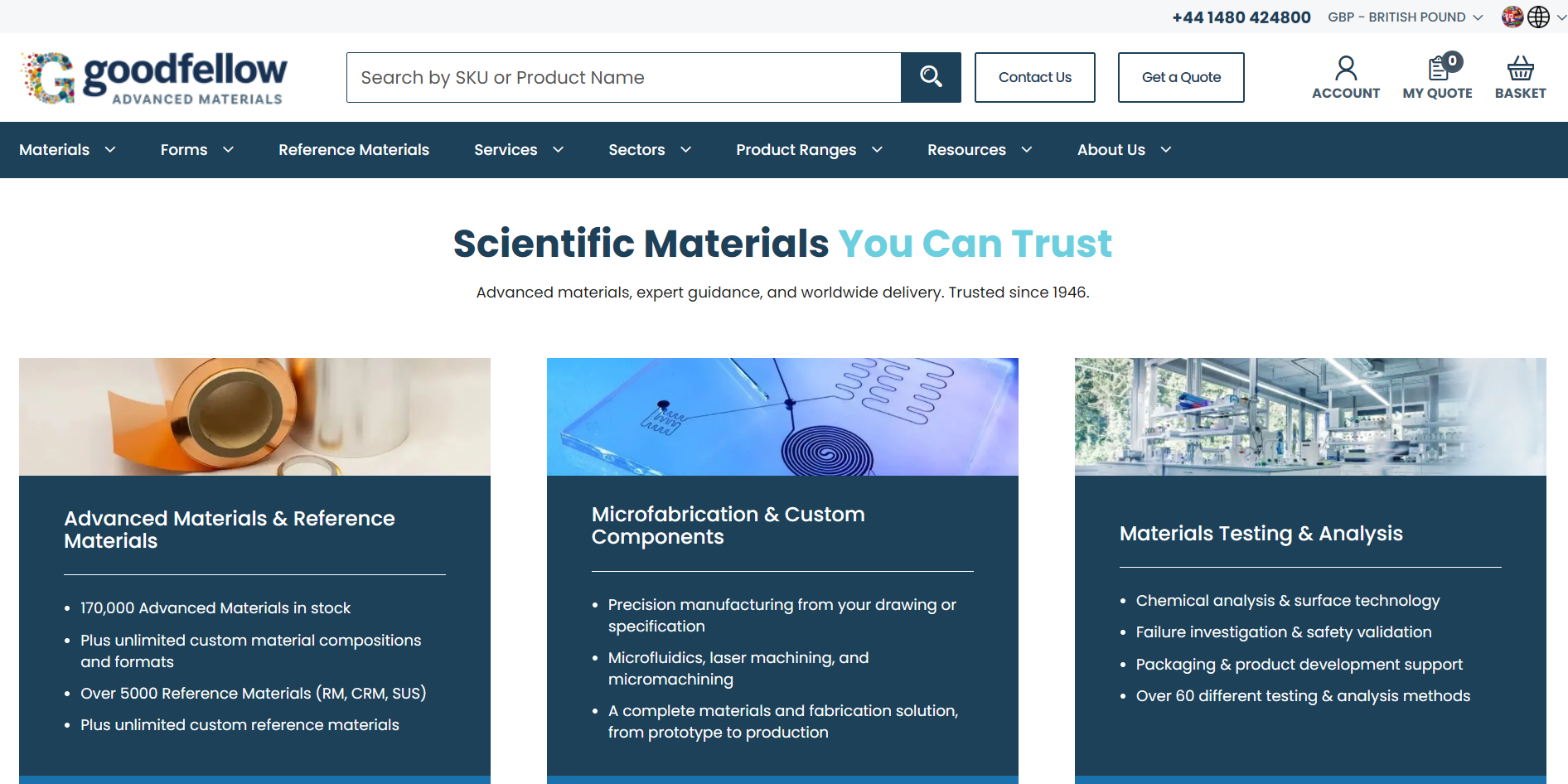
Goodfellow provides microfabrication and micromachining services through Potomac Photonics, the microfabrication division of the Goodfellow Group. Together, Goodfellow’s advanced-materials expertise and Potomac’s micro-scale manufacturing capabilities support projects that require both specialized materials and precision processing.
Available processes include laser micromachining, small-hole drilling, laser welding, laser patterning, micro CNC machining, micro 3D printing, hot embossing, bonding, and assembly. Services can support early-stage prototypes, process development, and repeat production, subject to the project’s material, geometry, tolerances, volume, and inspection requirements.
Key Takeaways
- Goodfellow delivers its microfabrication services through Potomac Photonics.
- Available processes include drilling, cutting, patterning, welding, CNC machining, 3D printing, embossing, bonding, and assembly.
- Supported material categories include metals, polymers, ceramics, glass, silicon wafers, films, and other specialized forms.
- Project feasibility depends on the material, feature geometry, tolerances, production volume, operating conditions, and inspection requirements.
Key Features of Goodfellow Microfabrication
Material and Microfabrication Expertise Within One Group
Goodfellow can address the material specification and the microfabrication process as part of the same project discussion. This is especially valuable when material grade, composition, purity, thickness, or surface condition could affect the manufacturing result.
For example, polymers with similar general properties may respond differently to a particular laser wavelength. Metals may also require different process settings based on reflectivity, thermal behavior, thickness, and feature size.
Before starting a project, confirm whether Goodfellow will supply the material, process customer-supplied material, or recommend an alternative substrate. Specify any requirements for material traceability, certificates, testing, or supporting documentation.
Support From Prototyping Through Production
Goodfellow and Potomac support projects from initial prototyping through production manufacturing. Prototype work can help evaluate material behavior, test feature geometry, refine process parameters, and prepare a design for repeat production.
Before moving into production, confirm expected volumes, acceptable variation, inspection methods, process controls, packaging, and documentation. Production capacity, lead times, and minimum order requirements should also be verified for each program.
Coordinated Processing for Complex Components
Components that require multiple manufacturing steps can combine processes such as drilling, cutting, patterning, welding, embossing, bonding, and assembly. A microfluidic device, for example, may require channel or hole formation followed by alignment, bonding, welding, or final assembly.
For multi-process projects, confirm which operations will be performed within the Goodfellow Group, which facility will handle each stage, and whether any work will be coordinated through outside suppliers.
Microfabrication and Micromachining Capabilities
The right manufacturing process depends on the material, feature geometry, tolerances, surface requirements, and production volume. Goodfellow and Potomac publish the following microfabrication capabilities.
| Process |
Typical Uses |
Key Points to Confirm |
| Small-hole drilling |
Microholes in polymers, metals, ceramics, glass, and silicon wafers |
Hole diameter, aspect ratio, taper, spacing, and edge condition |
| Laser micromachining |
Cutting, drilling, ablation, patterning, and fine-feature processing |
Material compatibility, tolerance, surface quality, and heat-affected zone |
| Micro laser welding |
Joining miniature metal or polymer components |
Material combination, joint design, weld depth, sealing, and distortion |
| Laser patterning |
Coating removal, marking, electrical isolation, and functional patterns |
Line width, processing depth, registration, and impact on the substrate |
| Micro CNC machining and micro 3D printing |
Small three-dimensional parts, prototypes, molds, and fixtures |
Material, feature size, tolerance, surface finish, and build dimensions |
| Hot embossing |
Replicated channels and micro-patterns in thermoplastic materials |
Polymer type, pattern depth, replication area, tooling, and quantity |
| Bonding and assembly |
Adhesive dispensing, encapsulation, welding, alignment, and assembly |
Alignment tolerance, joining method, cleanliness, and testing |
Laser Micromachining
Laser micromachining removes or modifies material without physical tool contact. Potomac uses laser sources ranging from deep-ultraviolet excimer systems to Nd:YAG lasers and selects the process based on the material, feature size, tolerances, and production volume.
The process can be used with metals, polymers, ceramics, and glass for operations such as cutting, drilling, ablation, patterning, and the production of small-feature molds or fixtures.
Laser selection affects feature resolution, processing speed, edge quality, and thermal impact. In addition to nominal dimensions, project specifications should address acceptable burrs, recast, discoloration, surface finish, and heat-affected zones.
Small-Hole Drilling
Small-hole drilling is available for polymers, metals, ceramics, silicon wafers, and glass. Goodfellow states that its capabilities can address microhole requirements with features as small as one micron.
This figure does not apply universally to every material or design. Achievable diameter, taper, aspect ratio, positional accuracy, edge condition, and throughput vary based on the material and component geometry.
Micro Laser Welding
Micro laser welding applies controlled energy to a localized area to join small components. Goodfellow describes capabilities for metals and polymers, including clear-to-clear and clear-to-opaque polymer joining.
The process can be used for miniature assemblies where excessive heat, distortion, substrate damage, or weld spatter could affect the finished part. Confirm the material combination, joint design, weld depth, sealing requirements, and inspection method for each application.
Laser Patterning
Laser patterning selectively removes or modifies a coating, film, or substrate surface. Published applications include direct patterning of coatings such as metallized Kapton and shallow marking on a range of substrate materials.
The appropriate laser and process conditions depend on whether the project requires coating removal, electrical isolation, surface texturing, marking, or a functional micro-pattern.
Micro CNC Machining and Micro 3D Printing
Micro CNC machining provides a mechanical manufacturing option for small parts and three-dimensional features that may not be practical to produce with laser processing alone. Micro 3D printing supports prototypes and small structures manufactured directly from digital design files.
Goodfellow’s published micro 3D printing services include CAD file transfer, post-processing, quality control, and replication. Confirm available materials, minimum feature sizes, dimensional tolerances, surface finish, and post-processing requirements for the specific project.
Hot Embossing
Hot embossing replicates micro-scale patterns in thermoplastic materials by applying heat and pressure with a patterned mold. Goodfellow lists materials such as polystyrene, cyclic olefin copolymers, PMMA, and polyethylene.
The process is commonly used for microfluidic devices and other polymer components that require repeatable channels or surface patterns across a defined area.
Bonding and Assembly
Goodfellow’s bonding and assembly services include laser micro-welding and precision epoxy dispensing. Published material examples include stainless steel, nickel-titanium alloys, thermoplastics, and other organic materials.
Precision dispensing can support electronic and optical assemblies that require small adhesive deposits, encapsulation, or underfill. Laser joining can be used when the design calls for localized heating and a controlled joint between miniature components.
Materials Goodfellow Can Support
Goodfellow and Potomac publish microfabrication capabilities for several material categories, including:
- Metals and alloys, including stainless steel, copper, titanium, nitinol, tantalum, gold, and aluminum
- Polymers and films, including Kapton, Cirlex, PEEK, polystyrene, PMMA, polycarbonate, PTFE, and Mylar
- Ceramics
- Glass, including borosilicate glass
- Silicon and silicon wafers
- Thin metal foils, polymer films, tubes, coatings, and other specialized material forms
These examples are not a complete compatibility list. Processing behavior can vary by grade, composition, fillers, color, thickness, coating, and surface condition.
If the original material specification presents manufacturing challenges, ask whether Goodfellow can recommend another grade, thickness, or material form that meets the component’s functional requirements.
Applications and Example Projects
Medical Devices and Life Sciences
Published application examples include micro-hole drilling in balloon catheters, microfluidic device fabrication, polymer processing, and miniature welded components.
Medical-device projects should define requirements for material records, cleanliness, inspection, process validation, and regulatory documentation. Confirm which services and quality systems apply to the specific program.
Electronics and Microelectronics
Laser patterning, small-hole drilling, precision cutting, epoxy dispensing, and micro-scale assembly can support electronic and microelectronic components.
Potential requirements include patterned films, small apertures, selective coating removal, alignment, encapsulation, and underfill. Include electrical specifications when a coating or pattern performs a conductive, insulating, shielding, or optical function.
Photonics and Optical Components
Photonics projects may require small apertures, controlled patterns, precision fixtures, or assemblies with strict alignment requirements.
Specify optical surfaces, restricted processing zones, contamination limits, alignment tolerances, and acceptable cosmetic defects when these factors affect component performance.
Microfluidics
Microfluidic devices may combine drilling, channel formation, patterning, embossing, alignment, welding, bonding, and assembly. Goodfellow and Potomac publish services that cover several stages of this manufacturing process.
Project specifications should define channel geometry, port dimensions, substrate material, bonding method, pressure requirements, fluid compatibility, optical requirements, and leak-testing criteria.
CHECK Find a Partner That Matches Your Microfabrication Requirements
Goodfellow provides microfabrication and micromachining services through Potomac Photonics, combining advanced-materials expertise with processes such as laser micromachining, small-hole drilling, laser welding, laser patterning, micro CNC machining, micro 3D printing, hot embossing, bonding, and assembly.
The company may be a relevant option for projects in which material properties, feature geometry, and processing requirements need to be evaluated together.
Goodfellow and Potomac support projects from early-stage prototyping through production manufacturing across metals, polymers, ceramics, glass, silicon wafers, films, and other specialized material forms.
Before shortlisting the company, confirm material compatibility, achievable tolerances, inspection requirements, production volume, lead time, and documentation needs.
This site features a range of microfabrication service providers to help companies compare potential manufacturing partners based on their materials, processes, production requirements, and project specifications.
How to Evaluate Goodfellow and Prepare an RFQ
Evaluate Goodfellow against the material, manufacturing process, and technical specifications required for the component. The relationship between Goodfellow’s materials business and Potomac’s microfabrication capabilities is most relevant when a project requires both specialized materials and micro-scale processing.
Provide enough information for the engineering team to evaluate feasibility and recommend a manufacturing approach. Include the following details whenever possible:
- A 2D drawing or 3D CAD file
- Material type, grade, and thickness
- Critical dimensions and tolerances
- Required feature geometry and surface quality
- Prototype quantity and expected production volume
- Operating conditions, including temperature, environment, and mechanical stress
- Inspection, documentation, delivery, and commercial requirements
Ask Goodfellow to confirm material compatibility, the proposed manufacturing process, achievable feature sizes and tolerances, inspection methods, production support, lead time, and any recommended design or material changes.
Company Information
| Company Name |
Goodfellow |
| Head Office |
Unit C1, Ermine Business Park, Huntingdon, Cambridgeshire, United Kingdom |
| UK Telephone |
+44 (0) 1480 424800 |
| UK Email |
info@goodfellow.com |
| U.S. Office |
Suite 270, 301 Grant Street, Pittsburgh, PA 15219, USA |
| Other Global Offices |
Hamburg, Germany
Lille, France
Shanghai, China |
| Quality Certification |
ISO 9001 |
| Website |
https://www.goodfellow.com/global/ |